For visual culture
Future audience pathwayKeep the work, the edition, and the permission legible.
For artists and creators, the vault is intended to connect original works, reproductions, commissions, derivatives, campaigns, and authenticated objects to the rights and approvals that actually govern them.
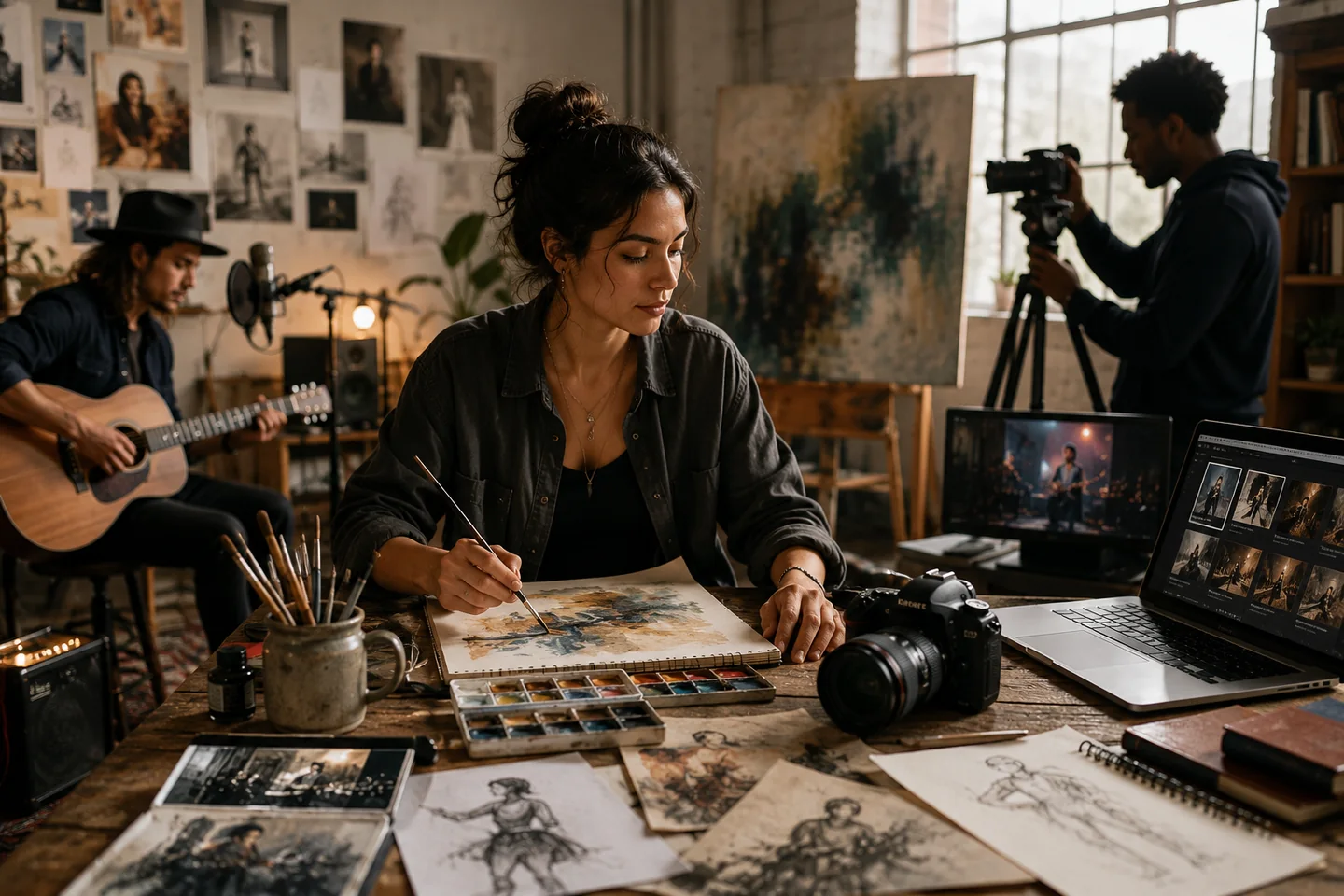
AI-generated artists and media collaborators coordinate a mixed-media project. This is an illustrative scene; no Image Rights Vault customer relationship is implied.
Works and versions
One project can contain several different rights objects.
An original object, its documentary photograph, a print reproduction, a campaign crop, a commissioned variant, and a digital derivative are not interchangeable. Each can have different authors, owners, licenses, approvals, and permitted editions.
A source-to-derivative record is intended to show how those objects relate, who approved a version, and what a recipient is actually receiving—without implying that provenance metadata settles a legal dispute.
Campaigns
Creator and influencer work needs scoped commercial terms.
A campaign record can separate production, posting, paid-media use, whitelisting, exclusivity, edits, approvals, renewal, affiliate or referral attribution, and disclosure obligations. The license should match the work actually commissioned.
Brand payment does not automatically transfer every copyright or likeness right. Conversely, owning the original artwork does not automatically confer the right to reproduce it commercially.
Editions
Lock the edition before the first serial is treated as authentic.
An edition record should identify the approved master, product specification, edition size, proofs or artist copies, serial convention, signing and witness method, replacements, and retirement policy. Duplicate serials and unapproved variants should fail closed.
The public record can confirm limited facts about an item while preserving private source files, contracts, addresses, and detailed financial information.
Plain-language licensing
Say what is allowed—and what is not.
A useful license states whether the recipient may display, reproduce, distribute, edit, create merchandise, sublicense, use in paid media, or involve AI. Anything excluded remains excluded unless a later written grant changes the scope.